There is a particular kind of joy that comes from being bad at something new. Maybe it is a wobbly first watercolor brushstroke, clumsy fingers fumbling through a language app, or a half finished scarf that took three tries. For a lot of older adults, that feeling, the one we usually associate with childhood, is one of the most rewarding parts of getting older. Lifelong learning after 65 is not about going back to school. It is about staying open.
At Stoneridge Creek in Pleasanton, that spirit shows up everywhere. Surrounded by the rolling hills of the Tri-Valley, residents have access to a community built around curiosity and connection, the kind of growth that does not stop just because a birthday says you are supposed to slow down. Lifelong learning is not a luxury reserved for the energetic few. It is a research backed way to stay sharp, stay social, and stay yourself.
Why Lifelong Learning Matters More Than We Think
It is easy to assume the brain peaks in your thirties and coasts downhill after that. The research says otherwise. According to Harvard Health Publishing, new brain cell growth is possible even late into adulthood, and learning new things can help stimulate that growth (Harvard Health Publishing, 2016). The brain is not finished changing just because we are not finished living.
Rachel Wu, a psychology professor and aging researcher at UC Riverside, studies how people learn across the lifespan, and her findings push back on the idea that older brains cannot adapt. As Wu put it, “You don’t need much brain power to learn… Newborns can learn” (Matemba-Mutasa, 2026). If a newborn brain can learn, an 80 year old brain can too. The challenge has never been capability. It is whether we keep giving ourselves the chance.
What Lifelong Learning Actually Looks Like
Lifelong learning rarely looks like a classroom. More often it looks like a knitting circle, a poetry class, a discussion group that veers into a conversation about new technology instead of old memories. One retired physicist mentioned in recent reporting has spent the last decade taking poetry courses, writing verses on his phone whenever inspiration strikes, working through Shakespeare, Dickinson, and Poe well into his eighties (Matemba-Mutasa, 2026). He still thinks of himself as a student first.
A few ways older adults are putting that curiosity into practice:
- Taking a community college course on a subject that has always been intriguing
- Reading outside your usual genre, even if it feels like cheating on your favorite kind of book
- Learning a musical instrument, starting from absolute zero
- Joining a discussion group to stay engaged with ideas and people at once
- Trying a hands-on hobby like knitting or gardening if you have always been more of a reader
The specific activity matters less than the willingness to be a beginner again. Someone who learns best through books might benefit from something hands-on, while someone physically active might find new value in a discussion based class.
The Social Side Nobody Talks About Enough
There is a quieter benefit that has nothing to do with brain scans. It is connection. Susan Hoffman, director of the Osher Lifelong Learning Institute at UC Berkeley, put it simply: “Social connection and learning content reinforce each other powerfully” (Matemba-Mutasa, 2026). Loneliness has been linked to worse cognitive outcomes, while meaningful social engagement offers emotional connection and mental stimulation at the same time. Learning something new is rarely just about the subject. It is about who you learn it with, and that is part of what makes a place like Stoneridge Creek special.
Lifelong Learning at Stoneridge Creek
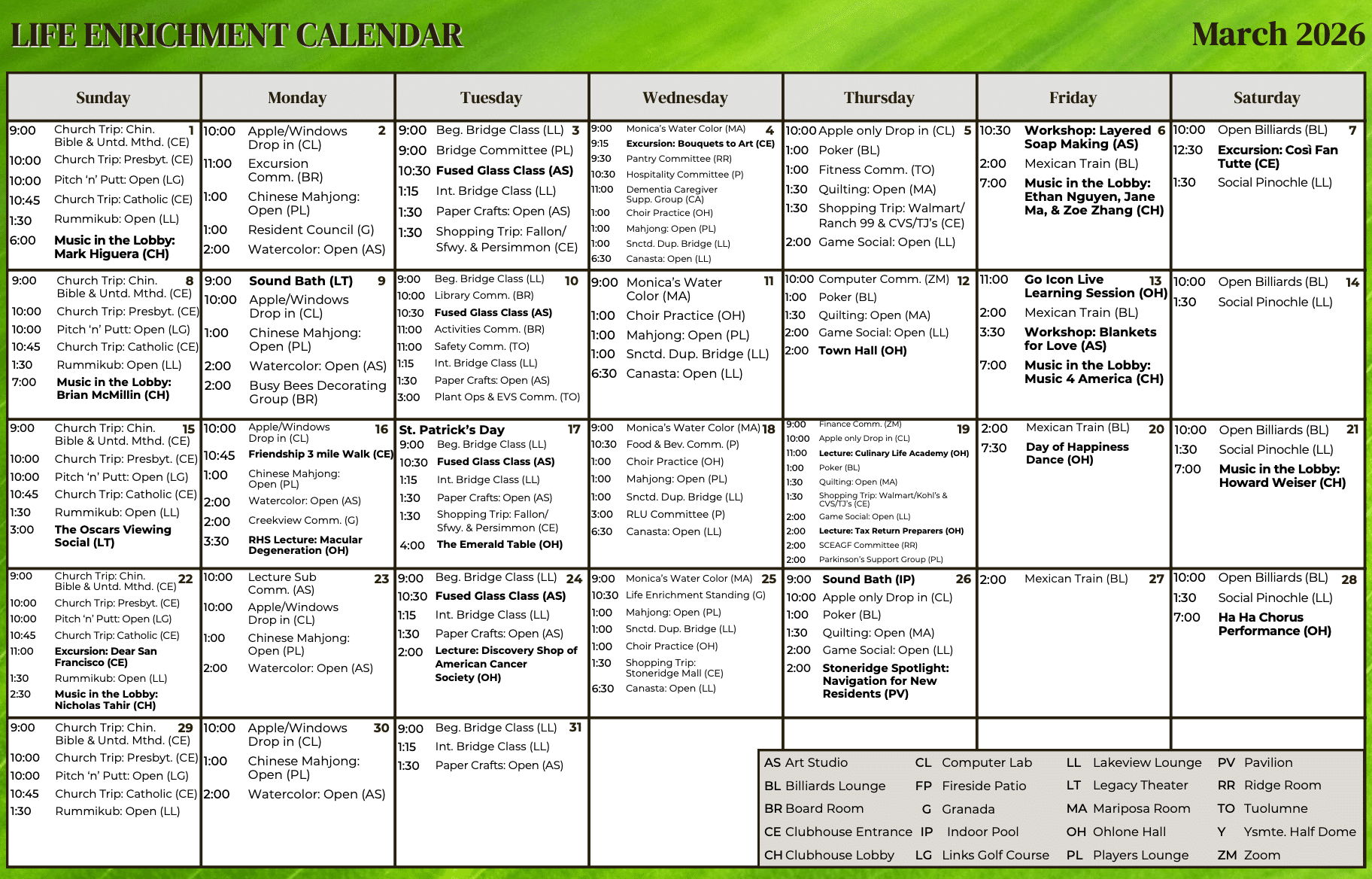
This philosophy is woven into everyday life at Stoneridge Creek, sitting right alongside the wellness and creativity programs that already shape the community. Whether someone wants to pick up a paintbrush for the first time or simply be around neighbors who are curious about the world, there is room for that here.
Lifelong learning after 65 is not about proving anything. It is about staying connected to the people around you and giving your mind permission to keep growing the way it was built to. At Stoneridge Creek, that is the whole point.
If you are ready to see what this looks like in person, click here to contact us and schedule a visit to Stoneridge Creek today.
References
Harvard Health Publishing. (2016, April 27). Back to school: Learning a new skill can slow cognitive aging. Harvard Health. https://www.health.harvard.edu/blog/learning-new-skill-can-slow-cognitive-aging-201604279502
Matemba-Mutasa, P. (2026, June 20). How lifelong learning helps older adults stay sharp and connected. The Mercury News. https://www.mercurynews.com/2026/06/20/how-lifelong-learning-helps-older-adults-stay-sharp-and-connected/
Frequently Asked Questions:
Is it really possible to learn new skills as an older adult?
Yes. The brain continues forming new neural connections throughout life, which means learning ability does not disappear with age.
What are some easy ways to start learning later in life?
Simple starting points include taking a class on a topic of personal interest, picking up a new hobby, joining a discussion group, or learning to use a new piece of technology.
Does learning new things help with memory or cognitive decline?
Many researchers believe continued learning helps build cognitive reserve, the brain's ability to adapt and compensate for age-related changes.
Why is social connection part of the equation?
Learning alongside others adds emotional connection and mental stimulation at the same time, a combination that appears to support cognitive health more than learning alone.